This is the list of tamagotchi releases from WIKI :
- 1 The Tamagotchi Generation 1
- 2 The Tamagotchi Generation 2
- 3 Tenshitchi no Tamagotchi (Tamagotchi Angel or Angelgotchi)
- 4 Mesutchi and Osutchi
- 5 Mori no Tamagotch (Tamagotchi Forest)
- 6 Umi no Tamagotch (Tamagotchi Ocean)
- 7 TamaOtch
- 8 Debirutchi no Tamagotchi (Tamagotchi Devil or Devilgotchi)
- 9 Yasashii Tamagotchi
- 10 Santaclautch
- 11 Genjintchi
- 12 Mothra Tamagotchi
- 13 Arukotch
- 14 Mezamatch
- 15 Mechagotch
- 16 Tamagotchi Plus
- 17 Tamagotchi Connexion
- 18 Deka Tamagotchi
- 19 Hanerutchi
- 20 Chibi Tamagotchi (Tamagotchi Mini)
- 21 Tamagotchi Plus Akai
- 22 Ouchi no Deka Tamagotchi (Home Huge Tamagotchi)
- 23 Chou Jinsei Enjoi Tamagotchi Plus (Entama)
- 24 TamaStation
- 25 TamaStation 2
- 26 Tamagotchi Connection Version 3
- 27 Tamagotchi Kakeibo
- 28 Ura Jinsei Enjoy Tamagotchi Plus (UraTama)
- 29 Tamagotchi "MusicFever"
- 30 Tamagotchi School
- 31 Tamagotchi Connection Version 4
- 32 TamagoChu
- 33 Odenkun Tamagotchi
- 34 Furefure Tamagotchi
- 35 Tamagotchi Connection Version 4.5
- 36 Tamagotchi Restaurant
- 37 Family Iro Iro! Tamagotchi Plus
- 38 Tamagotchi Connection Version 5/Familitchi
The Tamagotchi Generation 1
The original Tamagotchi was released in 1996 in Japan and 1997 in America and Europe. There are 7 adult characters, two teen characters, one toddler character, and one baby character, for a total of 11 characters. One adult character is a "secret" character, which means that one cannot get it in the way that one can get the others. There are two "generations", Generation 1 (also known as P1) and Generation 2 (also known as P2). This version lacks a pause mode.
Growthchart 
 |
The Tamagotchi Generation 2
The two generations of original Tamagotchi have different characters and a different game in each, and a number of other minor differences, such as small differences in the Meal and Snack options and in the animation that is shown at the end of a Tamagotchi's life. It also has very different characters.
Growthchart
 |
 | ||||||||

Tenshitchi no Tamagotchi
(Tamagotchi Angel or Angelgotchi)
The Tenshitchi no Tamagotchi was released in Japan in August 1997 with three different designs. An English version, the Tamagotchi Angel, was released in America and Europe with four designs. Both versions are often referred to as the Angelgotchi.
The option to discipline in case of misbehavior which was in the original Tamagotchi was replaced by the option to praise for doing good deeds in the Angelgotchi. The caretaker could not make it do good deeds, however. The discipline meter was replaced by a good deeds meter accordingly.
The Angelgotchi features a sound sensor. Occasionally, when the Angelgotchi was eating candy, a bat would appear and try to take the candy away. The caretaker would then have to either make a loud noise or tap the Angelgotchi unit (which would make a noise which the sound sensor would pick up) to scare the bat away. If the bat successfully took the candy, the Angelgotchi's good deeds meter would go down.
There are five secret characters in the Angelgotchi. In the European and American versions the secret character Sabotenshi (cactus angel) was replaced by Kitsutenshi (smiling angel).
Growthchart
 |
 | |||||||||||||||||
Mesutchi and Osutchi
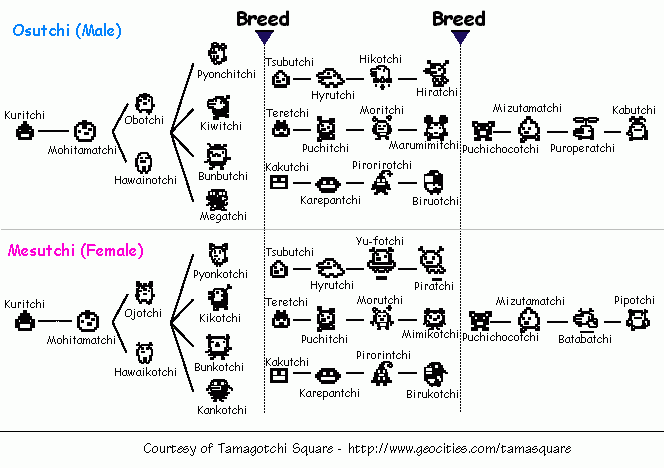
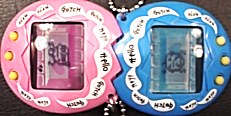
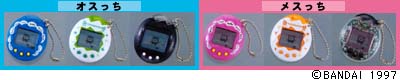
The Mesutchi and Osutchi were released in December of 1997 in Japan only. They feature interlocking mating using the same interlocking technology that Digimon used to connect, in which the tops of each Tamagotchi would lock together so that they could communicate with each other. When a Mesutchi and Osutchi connect in the adult stage, their mating may result to a child. Both Mesutchi and Osutchi feature 31 characters each. Five different generations of Tamagotchi are available, but only the first one grows in a way that is affected by caretaking skills; the other four are linear. If the caretaker is not responsible in their care for their Mesutchi or Osutchi, the Tamagotchi will become unmateable. If the caretaker feeds the Tamagotchi too much food and it and it becomes overweight, it will turn into a "Debutchi" which takes up the whole screen. In this state, the user can not do anything with the Mesutchi or Osutchi except play the game. (There is only one game.) The caretaker then has to lower the weight of the Tamagotchi by playing the game before normal functions may resume.
Growthchart
 |
 |
Mori no Tamagotch (Tamagotchi Forest)
The Mori no Tamagotch was released in February 1998 with four different designs. It was scheduled for release in America as "Tamagotchi Garden" bu
t was never actually released. This Tamagotchi introduced the "predator" function also used in the later Umi no Tamagotch (Tamagotchi Ocean). Occasionally a predator attacks, and the care taker has to use the sound-sensitive functions introduced in the Angelgotchi by shouting or tapping at the screen to frighten away the attacker. If the attack is a success, the Tamagotchi may become seriously injured or even die.
Another notable function of the Mori no Tamagotchi is the teenager phase: It is replaced by a cocoon, which remains for 24 hours, during which time the care taker controls a temperature dial. If the environment is mostly humid, the Tamagotchi will change into the "warmer" creature for that quality of care, and vice versa for cold weather.
There are two types of eggs that can b
e selected to hatch in this Tamagotchi. The white egg is more like a traditional Tamagotchi, where it changes based on how it is cared for. The spotted egg always changes into "Kabutchi", the stag beetle, where the goal is to make your pet as large as possible (a "length" meter is displayed to track this).He loves all other characters and makes a good friend.
 |
 | ||||||||||||||
Umi no Tamagotch (Tama
gotchi Ocean)
The Umi no Tamagotch (a.k.a Tamagotchi ocean) was released in March of 1998 in Japan in four different colors. It was also released in the United States in 1998 in four colors (though they were different from the Japan colors) as "Tamagotchi Ocean". This is known as one of the most difficult Tamagotchi to raise, needing near-constant attention. This Tamagotchi includes the "predator" function also used in the Mori no Tamagotch. Occasionally, a polar bear will attack while the Tamagotchi rests. Therefore, the caretaker has to use the sound-sensitive functions by tapping on the unit or shouting to scare away the predator. Like in Mori no Tamagotch, if the attack is successful, the Tamagotchi may become very ill and may even die. The Tamagotchi includes a "water quality" meter in the status screen. Flushing the screen makes the screen "cleaner," but if all four skulls on the meter are filled, the water becomes "murky" and it has to be flushed in order to view the Tamagotchi again. This is a secondary u
se for the cleaning function is not used in any other Tamagotchi made recently.
 |


TamaOtch
The TamaOtch was released in April of 1998 in Japan only. It was named after Japanese actress Tamao Nakamura. The Tamagotchi is a movie star. The caretaker trains TamaOtch for movie performances. This was the first Bandai virtual pet to be based upon a humanoid character. The training function is different from most Tamagotchi, in which the caretaker trains the character in different rehearsal situations. There are three routines - Ad Lib/Drama, Acting and and Dancing. There is only one design - pink with a white pattern, red buttons and blue screen trim. It also has sound sensitivity; the caretaker can interact with the character by tapping the casing of the unit or making a loud sound. It does not have a calling icon like most Tamagotchi do. Japanese characters flash on the screen when attention is required instead.


Debirutchi no Tamagotchi (Tamagotchi Devil or Devilgotchi)
The Devilgotchi was released in Japan only in September 1998 in four different colors for ¥2079. Some aspects of the care are similar to t
he Tenshitchi no Tamagotch (Tamagotchi Angel, Angelgotchi), only the Devilgotchi Power is supposed to be kept at a minimum, while the Angelgotchi Power is supposed to be kept at the maximum. Care is almost exactly the same as Angelgotchi, but unlike the Angelgotchi characters, who are eager and do good deeds for the caretaker, the Devilgotchi characters are naughty and play tricks on the caretaker. The Devilgotchi game was almost the same as the Angelgotchi game, but unlike the Angelgotchi game where the caretaker has to help the Angelgotchi jump over the stars, on the Devilgotchi game, the caretaker has to help the Devilgotchi catch the stars in its mouth so it could devoure them. It uses a sound sensor similar to the one used in Angelgotchi.


Yasashii Tamagotchi
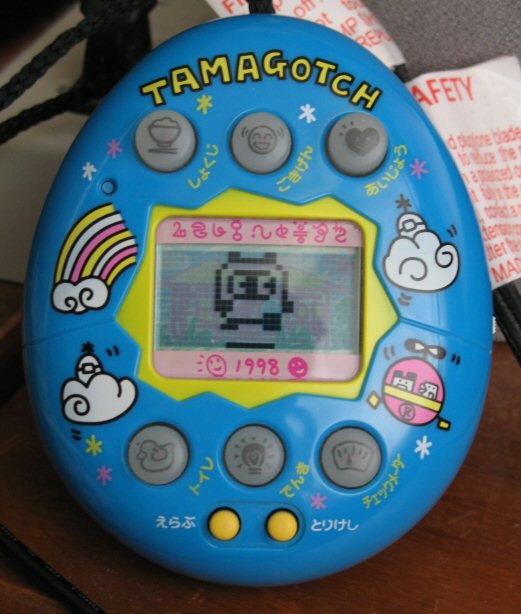
The Yasashii Tamagotchi was released in Japan in October of 1998 in four colors. Acting as an "Easy Tamagotchi", it has slightly different evolutions than the first set of Tamagotchi toys, and also features a larger case. In the place of icons, backlit buttons were used, and the number of buttons at the bottom of the case were reduced to two: Select and Cancel. Today, it is one of the rarest Tamagotchi that exists. It will almost always sell for at least $100 in both retail and auction sites

Santaclautch
The Santaclautch is a Santa Claus and Christmas-themed Tamagotchi which was released in December 1998 in Japan only. The Santaclautchi character does not evolve, but can be changed by means of equipping different items. The goal of the caretaker is to prepare Santaclautchi to go to each Tamagotchi's house, assisted by the care taker, and give them a present. If Santaclautchi does not deliver the presents in time, the Tamagotchi in the house gets mad, Santaclautchi gets upset, and the care taker has to start over. Sometimes, Santaclautchi won't feel like being 'Santa' and will selfishly leave the screen. The owner would then have to call "Super Kuchipatchi" to drag him back to the screen.


Genjintchi
The Genjintchi is also known as the pre-historical Tamagotchi. Genjintchi was released in November 1997, only in theatres playing the movie "Peking Man", which is the movie the virtual pet is based on. It is very expensive, due to its rarity. The characters are cavemen-like with the appearance of many bones.
There is only one casework style, brown with bones around the screen and the title 'GENJINTCH' on the top in red. Instead of death, the Genjintchi shows the Kanji symbol for 'Kan', meaning 'End'.
 |
Mothra Tamagotchi
The character which the caretaker would have to take care of is a winged beast called Mothra Tamagotchi. It was released in Japan in December 1997, to promote the Rebirth of Mothra movies. Mothra would hatch as the Larval version of the movie character, and evolve depending on care into one of its super powered forms, such as Rainbow Mothra. The programming is similar to the Morino Tamagotchi. Godzilla was also a hidden character.


Arukotch
Arukotch is not exactly a virtual pet, unlike most Tamagotchis. It is a combination of a pedometer and a game. When the user walks while wearing it, a character in the Arukotch called Arukotchi walks on the screen, and she may meet a boy Tamagotchi. Arukotchi may also find an item which makes her more attractive to the other Tamagotchi while she walks.

 |
Mezamatch
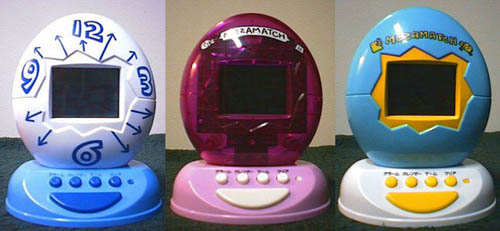
Mezamatch is a combination clock and virtual pet. It resembles a large Tamagotchi. You can also save dates, like anniversaries and birthdays on it.
 |
Mechagotch
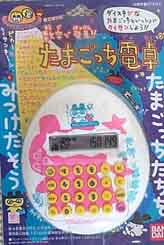
Mechagotch is a calculator. There are two modes which one can use it in, in addition to three games. One mode is a normal calculator, and one is a calculator with a Tamagotchi who reacts in different ways depending on the calculation. When one first uses this mode, there is an egg on the screen. It hatches into a different character depending on the last two or three digits in the answer to the first calculation which the user does in this mode. After the character hatches, the character reacts in different ways depending on the answer to the subsequent calculations. The numbers also show up in different ways depending on the character (for example, the answer might show up right away, or they might "spin" through several numbers in a similar way to a slot machine, depending on the character).
There are also three games. The first game is a kind of blackjack game, the second game is a game in which the player has to guess whether the number is higher or lower than the one displayed on the screen, and the third game is a memory game.
 |
Tamagotchi Plus
The Tamagotchi Plus was released in Japan on March 20, 2004. It is mostly the same as the Tamagotchi Connexion/Connection Version 1, the only major difference being the language. It includes characters from the original Tamagotchi as well as several characters new to the Tamagotchi series. It implements an infrared port to connect to other Tamagotchi to "make friends," play games and exchange presents with other Tamagotchi's (Tamagotchi Plus, Connexion, and Connection), including later models, and also breed and create a new generation of Tamagotchi. It can also connect to Deka (huge) Tamagotchi in Japanese retail stores and restaurants for an exclusive "friend". For more details, see Tamagotchi Connexion and Tamagotchi Connection.
 |
Tamagotchi Connexion
The Tamagotchi Connexion is the English-language version of the Tamagotchi Plus that was released in Oceania, Asia, and Europe. It is largely the same as the later U.S.-released Tamagotchi Connection, with slight changes in the wording of menu screens.
Deka Tamagotchi
These Tamagotchi were put in stores around Japan. The owner of a Tamagotchi could connect their Tamagotchi to get a special character on their friends list, and Keitais, Akais, TamaSukus, and Entamas could connect to buy items from the Deka. There are 4 main versions, Lotteria, Tamatama market, Game Station and Jukutama. There were not put for sale, but it is possible to buy them online.


Hanerutchi
The Hanerutchi features characters from the Japanese show "Haneru No Tobira" ("You Knock On The Jumping Door") and a small amount of Tamagotchi characters. It debuted in two colors with identical designs (white with green or red stripe and back), and a limited-edition metallic white with blue stripe was later released. It is similar to Keitai Tamagotchi with different characters.
Chibi Tamagotchi (Tamagotchi Mini)
The Tamagotchi Mini is a miniature Tamagotchi 66% of the size of the original toy which has limited features and is promoted as a fashion accessory. In Japan, the three colors available are identical to three of the six colors of the original Tamagotchi (pink, light blue, and white). The keychain attachment is a small ball-chain loop. In America, it debuted with four colors (black with flames, light blue, pink, and purple) and several months later followed with four more colors (yellow with dots, purple with dots, a darker blue, and yellow with stripes). The keychain attachment is a short link-chain with a lanyard clasp at the end. In Australia, it debuted with the Japanese colours, ball chain and packaging; but had American programming. There are 7 adult characters and a toddler (Marutchi), which are the same as the ones in the Generation 1 original Tamagotchi. There is also a secret character only available in the Japanese version (Unchi-kun). The Tamagotchi is also commonly-known for its glitches, such as the screen appearing blank for no reason.


Tamagotchi Plus Akai
The Akai was released July 23, 2005 in Japan. It is similar to the Keitai Tamagotchi but it features mono-color red LCD. There are new red-theme characters including a tomato, daruma, tengu, heart, and cherry, and new red-theme foods including pizza, wine, peaches, and red rice. The games are the same as the Keitai and Hanerutchi Tamagotchi with different graphics. It is capable of connecting with Japanese mobile phones, the Keitai Tamagotchi, Deka Tamagotchis at stores in Japan, the Home Deka, and the Hanerutchi Tamagotchi.

Ouchi no Deka Tamagotchi (Home Huge Tamagotchi)
Home Huge Tamagotchi (おうちのでかたまごっち o-uchi no deka tamagotchi) is a version of the "Huge Tamagotchi" which can be bought by individuals for home use. It was released July 2005 in Japan. It includes a stand for tabletop display, three-position volume adjust, and requires 2 AAA batteries.
The player is a female Tamagotchi character that initially lives in a small house in TamaTown. Through playing games and banking Gotchi Points, one can upgrade their house several times, the end result being a large Japanese-style palace. Each time an upgrade is performed, the capacity to keep various pets is increased. It is also possible to purchase a wide range of items to decorate the inside of the house, or to transfer over to the portable tamagotchi toys.
A special green-colored edition was sold at Japanese Toys-R-Us stores, available either paired with a matching akai series toy or alone.
Other versions of home deka were launched including Quishideka and Golden Deka.
 |
 |
Chou Jinsei Enjoi Tamagotchi Plus (Entama)
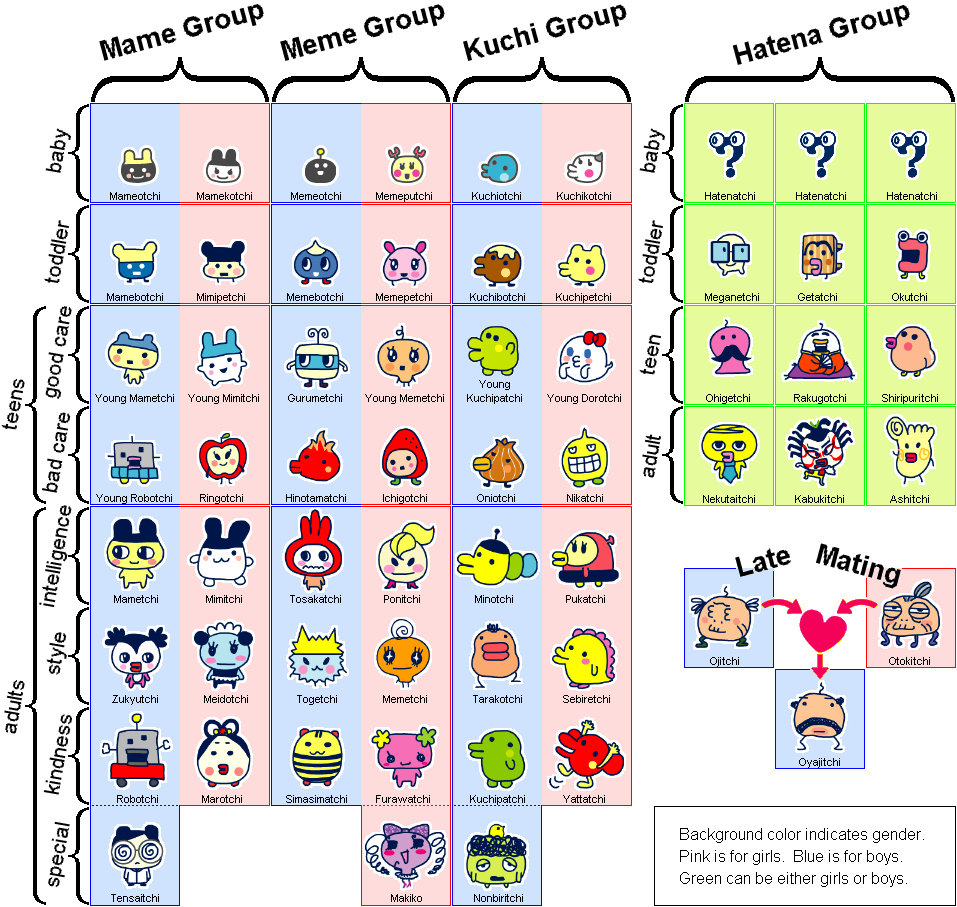
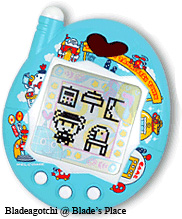
The Entama was released November 2005 in Japan. It is the first Tamagotchi with the ability to link to the computer. The user would be able to play with the Entama on the computer by going to this website: E-Tamago. From there, the user can enter Tamagotchi Town and take part in many activities and play many games. The user can even shop and buy things for the Entama, which are received via 14-digit passcodes. It can connect to the Home Deka, but can only trade points and not items. It includes three character groups: Intelligence, Kindness and Style, also known as Mamezoku, Kuchizoku, and Memezoku, respectively. A small strand of beads is attached rather than a keychain or mini-strap. The user can cook by mixing certain food items together. The food items that can be mixed are separate from the regular meal and snack items. There are a total of 58 characters featured on this Tamagotchi (42 Basic characters, three Secret Characters, two oldies, Oyajitchi and 10 Call Dating Service characters, also known as Hatenazoku characters). Thus, this Tamagotchi has the most characters featured on any Tamagotchi, beating the Version 3 and 4 by six characters.
The Entama is the first Tamagotchi to remove two of the Tamagotchi's original primary functions: the discipline and the lights (the Entama turns the lights out on its own at night, as opposed to most Tamagotchi, which would need the user to turn them off for them, or else they would get upset).
Entama were made with lifelike features, such as schooling and jobs (with job interviews). Unlike Tamagotchi Connexion/Connection, which has characters walking/floating around the middle of the screen, the characters walk on the bottom of the screen.
There is a Chou Jinsei Enjoi accessory available, called a Kakeibo (account book) Tamagotch. It is similar to the Home Deka. It features a touchscreen, and is quite big (10cm tall, 7.5cm wide), although the store Deka is larger. On the bottom of the egg it has 'TMGC TOWN GINZA STREET' engraved in it. There are no buttons on this accessory.
 | |||||||||||||
Growth Chart
TamaStation
Japanese arcades have launched a game that Tamagotchi could connect to, called Tamastation. It has a sequel called Tamastation 2.
TamaStation 2
This is the arcade sequel to the TamaStation that certain Tamagotchis can connect to like uratamas and entama to get a secret item.
Tamagotchi Connection Version 3
(Also known as Version 3, V3, Ver. 3 or Tama V3)
The Version 3 was released on February 18, 2006. Like the Version 2, it borrows some features from the latest version of the Japanese toy, but greatly simplifies them. This means that the V3 does not go to school, get a career, or receive a salary. It debuted with 6 new colors: Green with Tropical Flowers, Blue with Waves, Translucent Yellow, Arctic Camouflage, "Ice Cream," and Silver with Black Buttons. However, even newer colours were released later on, such as Blue with Bubbles and Graffiti. Only the first 6 colours were released elsewhere throughout the world. So far, the U.S. currently has the most V3 colours.
The Version 3 unit has a little bump on the top left side, like the antenna on a cell phone, similar to the Keitai Tamagotchi. The 'antenna' distinguishes it from the other versions. Note that in Japanese Tamagotchis, this 'antenna' can be used to connect to certain cell phones to allow the Tamagotchi to travel, but this feature was taken out in the U.S. version. There are over 20 new characters, many from Osutchi, Mesutchi and the Keitai, thus bringing the total number of Tamagotchi Connection characters to 52. It is able to connect with Version 1 and 2, as well as other V3 Tamagotchis.
The Version 3 can also be used with Tamatown.com which generates codes which the user can input into the toy and receive souvenirs, which are items that the user can look at (but the Tamagotchi can't play with or eat them). Passwords also give the shop items and food, which cost Gotchi Points. The Tamagotchi can eat the food that the user buys in Tamagotchi Town. Other than the code from the Nintendo DS Game, the passwords unlocked on the pet or on TamaTown.com will not work on any other Tamagotchi, thanks to the username system on both Tamatown and the Tamagotchi itself.
There are six new games, as well as new games that the Tamagotchi play with each other when connecting. The winner gets a certain amount of points depending on what stage the connecting Tamagotchis are in.
Some souvenirs "turn off" after each previous generation, which is not a glitch but a feature. Souvenirs 2 (Town Hall Key), 3 (Key #2), 7 (Clean up game medal), and Souvenirs 18 to 21 (Arcade items players can win for free) turn off when the new generation appears. These are free items users can turn back on if they saved the passwords that turned them on in the first place. Souvenirs that users pay for with Gotchi Points (The Trip souvenirs) or donate points for (Ring, Cape and Crown from the Tamagotchi King) do not turn off.
Seven codes are available on the Version 3 that unlock special items, similar to the five codes for the Version 2.
   |
Tamagotchi Kakeibo
The Tamagotchi Kakeibo (超やりくりエンジョイ!たまごっちかけいぼ chō yarikuri enjoi! tamagotchi kakeibo) is an accessory for the entama-generation Tamagotchi toys released in Japan.
It is slightly smaller than a home dekatama and very thin, as it is designed to fit into a small binder included with the toy. Inside the binder is a starter pack of "account book" (kakeibo) pages used to track the user's spending of "gotchi points", the currency used in all Tamagotchi toys. Initially released with a pink body and orange stylus, a later version released around the same time as the uratama features a blue body and green stylus, new screen background, and new binder cover (although with the same black-pixel LCD and programming).
The kakeibo is not really a virtual pet like the other portable tamagotchi, but more of a tool to assist with caring for them. Users play as Osewatchi (likely from the word o-sewa; help or aid), a female Tamagotchi who lives in Tamagotchi Town's Ginza district, which is the Tamagotchi Planet's version of the fashionable Tokyo shopping district. There are many stores which sell items users can transfer to their Tamagotchi pets, a bank to store money, as well as mini-games to earn that money and a library which can record which Tamagotchi characters players have discovered on their Entama and Uratama.

 |
 |
Ura Jinsei Enjoy Tamagotchi Plus (UraTama)
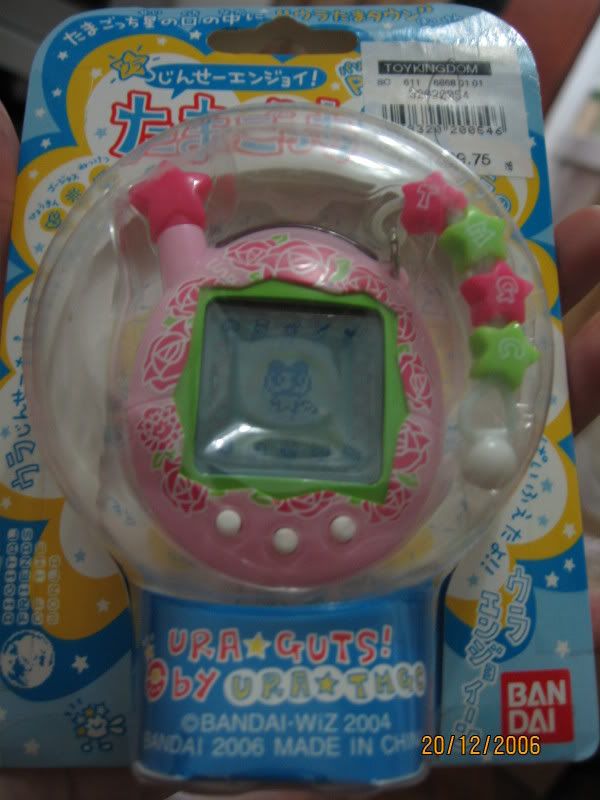
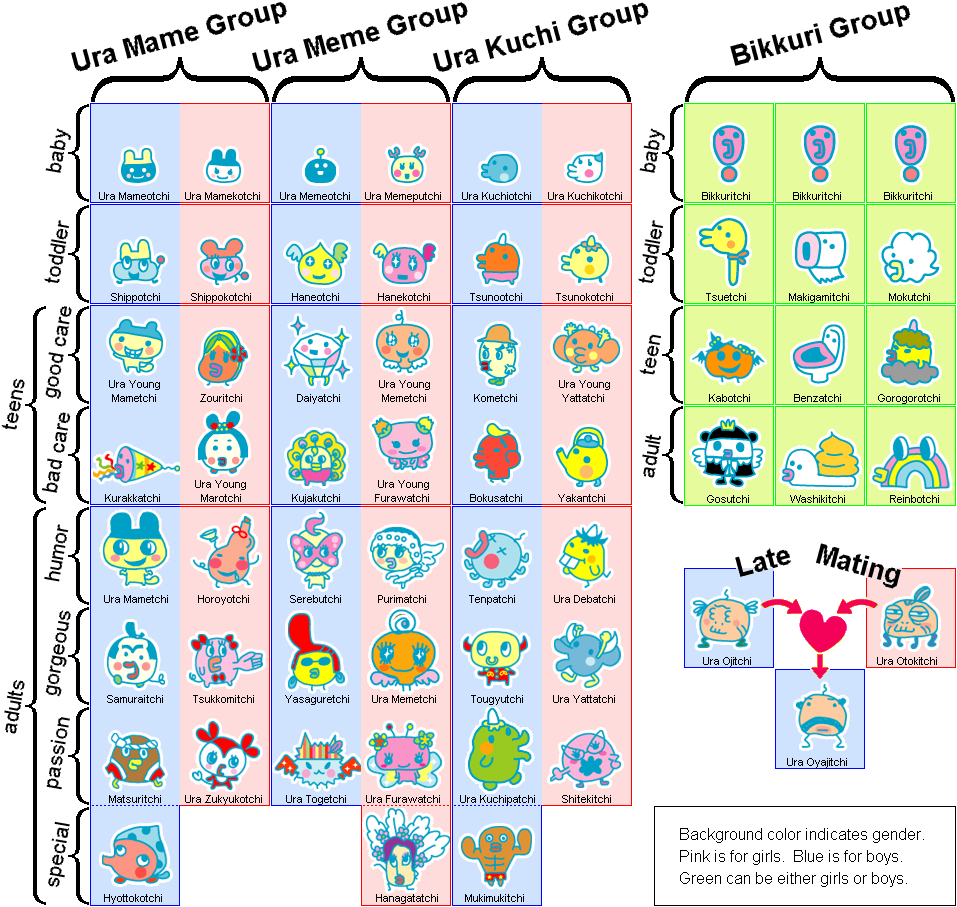
The UraTama has mono-color blue LCD, unlike most Tamagotchi, which have black LCD. It is similar to the EnTama, with a star replacing the round decorative "antenna" and beads; it is the blue-colored counterpart to the Keitai's red-colored "Akai series". It can connect with TamaStations, which are large gaming type centers all around Japan which can also connect to the DekaTamas, Entamas, and Keitai. Within the TamaStation, the user can earn special items by winning Games; for example: "Call dating service" which the care taker uses it to get special, Rare Character generations (three to earn).
There are currently 6 case designs. Some of the characters have dramatically changed in the UraTama, for example, Mametchi was renamed to Uramametchi, and features a tail, UraKuchipatchi has a horn on its head, and Uramemetchi has wings. The uracharacter has visits from seretant teachers and other characters such as its boss, robbers, mail man, and more.
 |
Tamagotchi "MusicFever"
The Tamagotchi "MusicFever" is a Tamagotchi that can record music off of CDs or cassette tapes. It is somewhat similar to the [[iPod][MP3]. There are also a few games that can be played on the MusicFever device.
Tamagotchi School
Tamagotchi School (たまごっちスクール tamagotchi sukuuru), also known as TamaSuku (たまスク), is the second newest Tamagotchi available in Japan, being released November 23, 2006. It is the second Tamagotchi that is horizontal, first being Arukotch. It also is the first Tamagotchi to use a directional pad, and the second Tamagotchi to have only "select" and "cancel" buttons, the first being the Yasashii Tamagotchi. It can connect to other Tamagotchi Schools for playing games, the Entama and Uratama to move in new students and exchanging "Gotchi Points", Tamagotchi Station, Tamagotchi Station 2, the "jukutama" (a Deka Tamagotchi for Tamasuku) and an interactive website where players can compete against other players.
The goal of Tamagotchi School is for the user to make their class a "supreme class" by enrolling new students, keeping up their popularity, and increasing their score in three main subject areas: National Language (i.e. Japanese), Arithmetic, and Science. Just like the three different skill areas of the Entama, Uratama, and Hanerutchi 2, players can increase these by playing games or buying stat-boosting items. There are two versions of the Tamagotchi School.
 |
Tamagotchi Connection Version 4
The Version 4 is loosely based on the Japanese "EnTama" series. It's name, JinSei, is Japanese, meaning "life". The V4 toys sold in Canada and the United States are currently available in 6 different shell designs, one of which was chosen by fans of the toy in late 2006 as part of Bandai's "Great Shell-ection" contest. The winning design is white with zig-zag stripes that glow in the dark. The packaging is identical to other V4 toys, except for a small trophy sticker that reads "Winning Design!".
Images of 18 of the Version 4 designs are displayed at tamagotchi.com, however this may not be a complete collection.
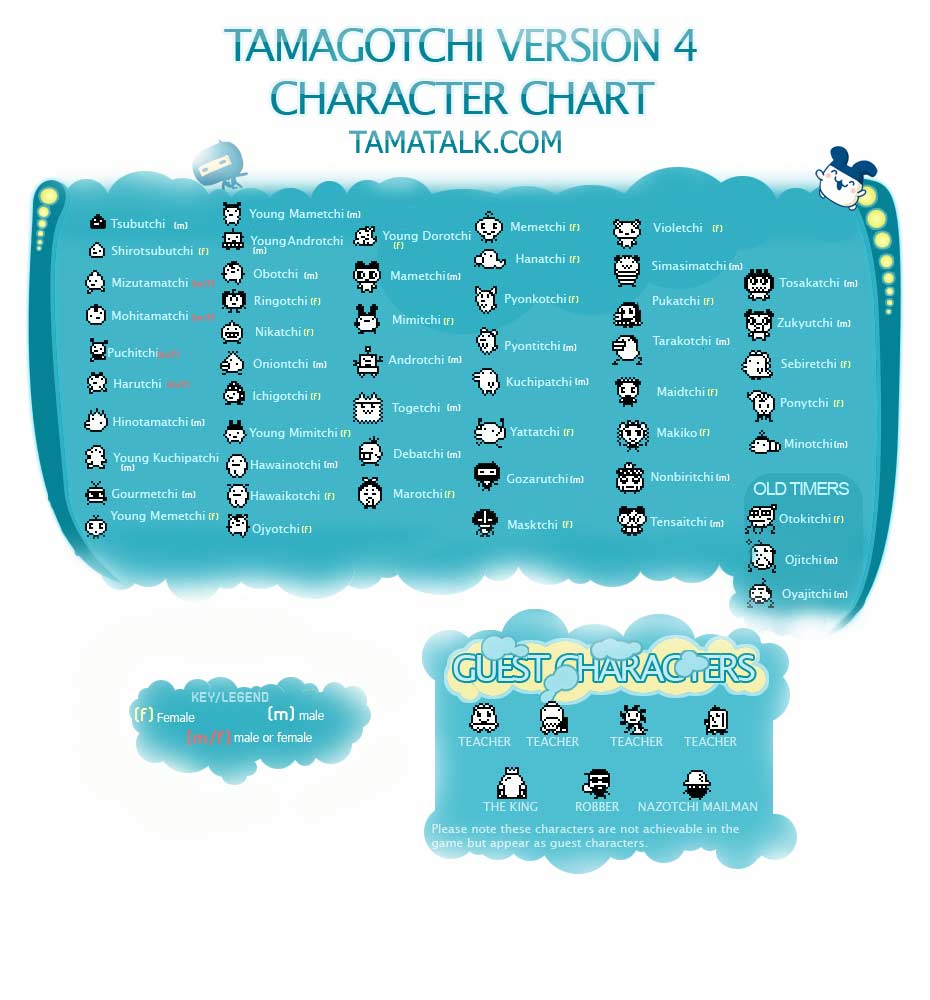
The Version 4 has a TamaTown separate from the TamaTown for the Version 3. By putting a password and username on the screen, the user can earn Gotchi Points in the Version 4 TamaTown. They will also be able to see their character on the computer screen. There is a school and a kindergarten that the Tamagotchi can visit in TamaTown. The characters are a combination of the ones from the Japanese releases "Chou Jinsei Enjoi Tamagotchi Plus" and the original "Tamagotchi Plus" as well as the Mesutchi and Osutchi Tamagotchi, emphasizing characters similar to and related to Mametchi, Kuchipatchi, and Memetchi.
The Version 4 has new and updated games. The games include Jumping Rope, Mimic, Dance, Shape, and Flag. [ The player's Tamagotchi may also get a job depending on how they raise their Tamagotchi. There is also a new mail feature.
- The star icon represents the Tamagotchi's fortune. If the user opens up this type of mail the screen will show certain icons and stars next to them. The icons include a money bag to represent money, a heart to represent friendship, and an action figure to represent health. The stars next to the icons represent how lucky the user's Tamagotchi will be, from one to three. For example, if there is one star by the action figure icon the Tamagotchi will be more likely to get sick, but if there are three stars, the Tamagotchi will be very unlikely to get sick.
- The mail icon represents regular mail. The Tamagotchi may get mail from the king, get robbed or other things may happen.
- The important mail icon is for information of the Tamagotchi's life, for example, if a teacher wants to invite the Tamagotchi to go to school. The Tamagotchi does not receive this type of mail often.
Tamagotchi Connection V4 has new connection options. Not only can the player go to this icon to connect to another Tamagotchi but can also use it to have their Tamagotchi go to school or to work.
The player can also "connect" to their computer to have their Tamagotchi in TamaTown which has info on the second paragraph. When the player wants to connect to another Tamagotchi they either can press V4 or Others. If the player presses V4 three options would pop up: Game, Present, and Visit. If the player chooses Games, the two Tamagotchi will compete in a randomly selected game for Gotchi points. If the player chooses Present, their Tamagotchi give the other Tamagotchi a gift. If the player chooses Visit, one Tamagotchi will go to the other Tamagotchi and spend time together. On the other hand, if the player chooses Others, they will be able to connect to the older Connections and the two Tamagotchi will randomly either give each other presents, or play a game with each other.

 |
TamagoChu
The TamagoChu were released at the end of January 2007 in Japan. TamagoChu is somewhat similar to Mesutchi and Osutchi, but is unique from other versions of Tamagotchi in several ways, such as the fact that there are two TamagoChu in each box; a boy and a girl TamagoChu, and that the TamagoChu character is selected after activating the device and setting the date and time; other versions of Tamagotchi required the user to fulfill certain tasks to obtain a specific character. Also, TamagoChu does not require any means of food and discipline, but rather requires to be connected to another TamagoChu every so often; the more two specific TamagoChu connect, the better their relationship. When two TamagoChu are connected when they are children they could receive a letter or a toy. If a TamagoChu unit does not connect often it would not like to connect again and won't be able to get married.
 |
Odenkun Tamagotchi
The Odenkun was released on March 31, 2007 only in Japan, and features a shop owner. It is based on a Japanese fish-like cartoon, called "The Adventures of Oden-kun".

Furefure Tamagotchi
The Furefure is another large Tamagotchi that can be connected the Tamagotchi School, or as a Deka or Oushi No Deka Tamagotch for the Tamagotchi School. It enables the students to play games. According to a translated version of the Tamagotchi Channel it is a Tamagotchi based on club activities, eg. football. It was released on April 28, 2007. The Furefure can also be referred to as a TamaFure, and Jukutama.
 |
Tamagotchi Connection Version 4.5
The Tamagotchi Connection Version 4.5, or the JinseiPlus in the UK, is the newest Tamagotchi released outside of Japan. It's a Tamagotchi based on the V4, but with new and updated features. Featuring many new characters, it is a remake of the "Ura Jinsei Enjoy" Tamagotchi, released only in Japan. It has different jobs to the V4, and slightly different features, but it shares the V4 " Tamagotchi Town. It retains the feature of skill points, but has new types of them: Funny, Gorgeous and Spiritual. It has five games to play, like the V4: Climb, Tug-Of-War, Apple, Shapes and Manhole. Just like Versions 2-4, it has secret codes that the player can enter into the Shop Keeper. The release date for the US was June 25 2007.The "antenna" on this verion is a star, but unlike the Ura Jinsei Enjoy it is not used for the connection.
Tamagotchi Restaurant
This Tama is different because it features both a 2D pixel screen and 3D playset. The toy comes in a flip-top compact that opens to reveal some Tamagotchi figurines. Placing them in different spots activates different actions. There are the tradition three buttons on the playset itself, along with the condiment buttons. The object of the game is to fill out orders. It was released July 28, 2007.
Family Iro Iro! Tamagotchi Plus
This Tamagotchi is the newest Tamagotchi to be released in Japan. It is nicknamed the FamiTama and was released on November 23, 2007. The new feature on this Tama is that you can raise a whole family of characters at the one time. To be able to all fit on one screen, Bandai widened the screen from 32x30 pixels to 48x32 pixels, now being capable of fitting 3-4 adults on one screen. Bandai also announced that they will be making an English version of this Tamagotchi, colloquially called the V5, and will be releasing it 6th of January 2008.
Tamagotchi Connection Version 5/Familitchi
This Tamagotchi is the next Tamagotchi in the Tamagotchi Connection Series. It is based on the FamiTama and is to be released in January 2008. A new feature is that you can raise Tamagotchi Families, with 3-5 parents and kids on it. It, however, is rumored that it may not be able to connect to the other Tamagotchis in the series.